Biol Psychiatry 2012; 71:138S-139S. [Paper presented at the at the 67th Annual Meeting of the Society of Biological Psychiatry (SOBP) in Philadelphia, PA, May 3 - 5, 2012.]
Neurophysiological correlates of working memory (WM) retrieval in schizophrenia during a serial position test with words or faces
Jürgen Kayser1,2, Craig E. Tenke1,2, Christopher J. Kroppmann1, Daniel M. Alschuler1, Shiva Fekri1, Roberto Gil2,3, Lars F. Jarskog2,4, Jill M. Harkavy-Friedman2, Gerard E. Bruder1,2
1 Division of Cognitive Neuroscience, New York State Psychiatric Institute, New York, NY
2 Department of Psychiatry, Columbia University College of Physicians & Surgeons, New York, NY
3 Clinical Psychobiology, New York State Psychiatric Institute, New York, NY
4 Department of Psychiatry, University of North Carolina at Chapel Hill, Chapel Hill, NC
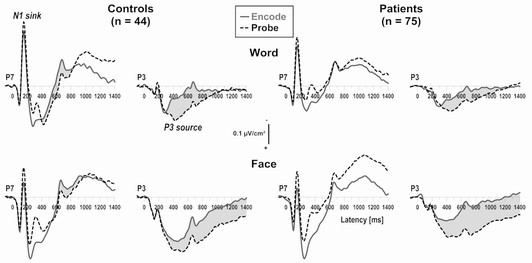
Abstract Background: The event-related potential (ERP) 'old/new' effect (enhanced parietal positivity 300-800 ms after correctly recognized repeated items) is a reliable neurophysiologic correlate of conscious recollection, which is reduced in schizophrenia during word but not face recognition (Kayser et al., 1999, 2009, 2010). This study examined whether the task-specificity of this effect also applies to WM retrieval. Methods: 67-channel ERPs were recorded from 75 schizophrenic patients and 44 healthy controls (right-handed) during a WM paradigm with words or faces. After sequentially encoding three items (500 ms, 1.5 s SOA), one item was repeated after a 3-s delay (probe), and its serial position was reported. Results: ERPs were transformed into reference-free current source density (CSD; spherical spline interpolation) waveforms, which were more positive for probe (old) than encoding (new) items, revealing differences highly similar to recognition memory old/new effects. An unrestricted Varimax-PCA identified positive sources peaking at 281 ms (parietoccipital) and 660 ms (centroparietal). Although both groups performed well in the word task (> 90% correct), probe/encode effects over left lateral-parietal sites for the 660 source were markedly reduced in patients. In contrast, probe/encode effects for this source were comparable in patients and controls for faces, despite poorer performance in patients (72.3±14.3% vs. 88.3±9.5%). Conclusions: The findings suggest that neurophysiologic abnormalities of conscious recollection in schizophrenia are specific to tasks requiring phonological encoding and/or semantic processing.
References Kayser J, Bruder G, Friedman D, Tenke C, Amador X, Clark S, Malaspina D, Gorman J (1999). Brain event-related potentials (ERPs) in schizophrenia during a word recognition memory task. International Journal of Psychophysiology 34(3):249-265. Key Words: schizophrenia, working memory (WM), ERP, old/new effect, current source density (CSD) [Supported by NIMH grant MH066597]. |