Paper to be presented at the 60th Annual Meeting of the Society of Biological Psychiatry (SOBP) in Atlanta, GA, May 19 - 21, 2005.
Verbal working memory (WM) in schizophrenia: event-related brain potential (ERP) findings for the Word Serial Position Test
Jürgen Kayser1,2, Craig E. Tenke1,2, Nathan A. Gates1, Chris J. Kroppmann1, Roberto B. Gil2,3, Gerard E. Bruder1,2
1 Biopsychology, New York State Psychiatric Institute, New York, NY; 2 Psychiatry, College of Physicians and Surgeans, Columbia University, New York, NY; 3 Clinical Psychobiology, New York State Psychiatric Institute, New York, NY
Abstract Background: Reduced WM is a primary cognitive deficit in schizophrenia. To better determine its functional and neuroanatomical origin (cortical activation during encoding, retention, or retrieval), advanced analytic techniques (current source density, CSD; principal components analysis, PCA; CSD animations) were used to exploit the high temporal resolution underlying 31-channel ERP topographies obtained during a verbal WM task based on the Word Serial Position Test (Wexler et al. 1998). Methods: Long EEG epochs (> 10 s; 0.01 Hz high pass) were recorded from 13 schizophrenic (9 male) and 17 healthy adults (8 male) during 128 visual trials consisting of 4 initial words (500 ms exposure, 1,500 ms SOA), a retention period requiring storage of the word sequence (4,500 ms), a probe word (500 ms), and a delayed button press to indicate its correct position. Reference-free CSDs of ERP waveforms were submitted to unrestricted, covariance-based, and Varimax-rotated PCA to identify and measure relevant neuronal generator patterns. Results: Poorer performance in patients (72.9±14.3% vs. 88.2±10.8% correct, p<0.01) was paralleled by reduced stimulus-related, left-lateralized (inferior-parietal) P3 source asymmetry (p<0.01) and amplitude (p<0.05) during encoding and retrieval. Healthy adults evidenced a sustained increase in mid-frontal sink activity during word encoding (up to 6 s), which was absent in patients (p<0.01). In contrast, a sustained frontocentral sink during the retention period and early, left-lateralized (inferior-parietal) N1 sinks were similar across groups. Conclusions: Electrophysiologic correlates of visual verbal WM deficits in schizophrenia suggest a complex disturbance in functional neuronal network processes, primarily affecting the encoding of successive stimuli. | 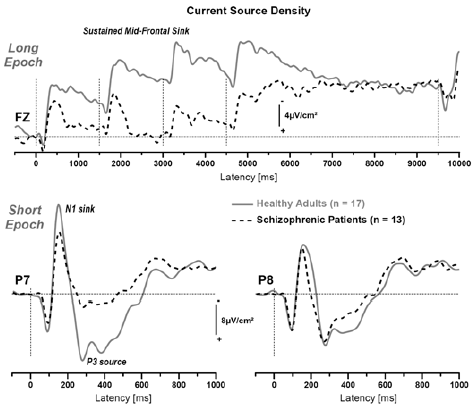 |
Reference Wexler BE, Stevens AA, Bowers AA, Sernyak MJ, Goldman Rakic PS (1998). Word and tone working memory deficits in schizophrenia. Arch Gen Psychiatry 55(12):1093-1096. | |