Biol Psychiatry 2012; 71:138S. [Paper presented at the at the 67th Annual Meeting of the Society of Biological Psychiatry (SOBP) in Philadelphia, PA, May 3 - 5, 2012.]
Auditory hallucinations in schizophrenia are associated with a neurophysiological deficit in early visual processing
Jürgen Kayser1,2, Craig E. Tenke1,2, Christopher J. Kroppmann1, Daniel M. Alschuler1, Shiva Fekri1, Roberto Gil2,3, Lars F. Jarskog2,4, Jill M. Harkavy-Friedman2, Gerard E. Bruder1,2
1 Division of Cognitive Neuroscience, New York State Psychiatric Institute, New York, NY
2 Department of Psychiatry, Columbia University College of Physicians & Surgeons, New York, NY
3 Clinical Psychobiology, New York State Psychiatric Institute, New York, NY
4 Department of Psychiatry, University of North Carolina at Chapel Hill, Chapel Hill, NC
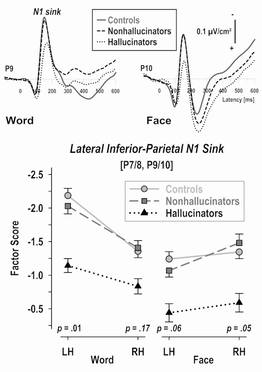
Abstract Background: Prior studies suggest that auditory hallucinations interfere with processing of spoken words or tones. However, this hypothesis has rarely been tested using event-related potentials (ERPs). We examined visual ERPs of schizophrenia patients who are prone to auditory hallucinations. Methods: Using 67-channel ERPs recorded during working memory paradigms with words or faces, we compared right-handed schizophrenia patients who either reported auditory hallucinations (n = 21) or not (n = 47) and healthy controls (n = 44). ERPs were transformed into reference-free current source density (CSD) waveforms, which included distinct N1 sinks (approximate peak latency 150 ms) over lateral inferior-parietal sites (P7/8, P9/10) that were strongly left-lateralized for words but right-lateralized for faces (N170). CSDs were submitted to unrestricted Varimax-PCA separately for each paradigm to quantify N1 sink activity. Results: N1 sink was substantially reduced in hallucinators compared with controls and nonhallucinators, who did not differ from each other. For words, the N1 sink reduction in hallucinators was greatest over the left hemisphere, with no significant group difference over the right hemisphere. For faces, group differences were similar over each hemisphere but less robust. Conclusions: These findings in the visual modality extend those of Hubl et al. (2007), who reported N1 reductions to tones over left temporal cortex in psychotic patients (n = 7) during auditory hallucinations, and suggest a broader early perceptual/attentional processing deficit in hallucinators.
References Hubl D, Koenig T, Strik WK, Garcia LM, Dierks T (2007). Competition for neuronal resources: how hallucinations make themselves heard. Br J Psychiatry 190:57-62. Key Words: schizophrenia; auditory hallucination; ERP; visual N1; current source density (CSD) [Supported by NIMH grant MH066597]. |