International Journal of Psychophysiology, 2018, 131S, S105. [Paper presented at the 19th World Congress of Psychophysiology, International Organization of Psychophysiology (I.O.P.), in Lucca, Italy, September 4-8, 2018.]
Mid-frontal theta as a measure of attention and cognitive control during new auditory WM tasks: preliminary findings for healthy adults and schizophrenia patients
Jürgen Kaysera,b, Craig E. Tenkea,b, Lidia Y.X. Wonga, Jorge E. Alvarengaa, Lindsey Casal-Roscuma, Kenneth Hugdahlc, Gerard E. Brudera,b, John Jonidesd
aNew York State Psychiatric Institute, Departments of Cognitive Neuroscience and Translational Epidemiology, New York, NY, USA; bColumbia University, Department of Psychiatry, New York, NY, USA; cUniversity of Bergen, Department of Biological and Medical Psychology, Bergen, Norway; dUniversity of Michigan, Department of Psychology, Ann Arbor, MI, USA
Abstract
Introduction: Proactive control, namely the ability to represent and manipulate goal information in working memory (WM), may be a common mechanism that drives cognitive deficits in schizophrenia (SZ). While WM studies in SZ have generally relied on visual paradigms, functional deficits in SZ, including hallucinations, are more prevalent and severe for the auditory than visual modality. We developed auditory analogs of visual Ignore/Suppress tasks conducted in conjunction with event-related potentials (ERPs) and oscillations (EROs) to examine the effects of selective attention and inhibitory control on auditory WM in SZ and healthy controls (HC). Key Words: schizophrenia; cognitive control; auditory WM; event-related potential (ERP); event-related osciallations (EROs); time-frequency analysis; mid-frontal theta; current source density (CSD); principal components analysis (PCA) [Supported by NIMH grant MH106905]. | 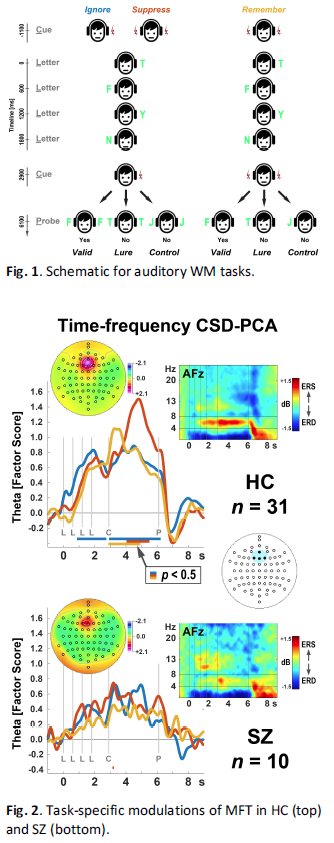 |